
Why Global Companies Build Software Teams in Bangladesh
{ BLOG DETAILS }
The honest version: what works well about building software from Dhaka, what takes deliberate effort, and how to tell a serious team from a body shop.
Introduction
The honest version: what works well about building software from Dhaka, what takes deliberate effort, and how to tell a serious team from a body shop.
Hiring
October 31, 20264 min read
Project Help
Share Article


HiringSoftware Development
We are based in Dhaka, so treat this as a piece written by an interested party. What follows is the version we would give a friend rather than the version on a landing page — including the parts that are harder.
What actually works
Timezone. Dhaka is UTC+6, which gives a full working-day overlap with Europe and the Middle East, most of the day with India and Singapore, and the first half of the US East Coast morning. For a European client this is close to ideal — you can have a real conversation at any point in your day.
Cost, with the caveat below. Rates are materially lower than Western Europe or North America. The honest framing is not "cheap engineers" — it is that the same budget buys a team rather than a single hire, which usually matters more than the hourly number.
Depth in the work most businesses need. Web platforms, mobile, cloud infrastructure, data pipelines, eCommerce. The talent pool is genuinely deep in the mainstream stack.
English. Technical English is standard; education and documentation are in English. Written communication in particular is strong, which is what distributed work actually runs on.
What takes deliberate effort
Quality varies widely. There is an enormous range between the best firms and the cheapest, wider than in markets where rates are higher. Selecting on price alone will find the bottom of that range reliably. The evaluation questions matter more here, not less — all ten of them.
Niche specialisms are thinner. Deep machine learning research, embedded systems, high-frequency trading infrastructure. For a mainstream product build this is irrelevant; for those specific needs it is a real constraint and you should hear it said plainly.
Holidays differ. Eid dates move with the lunar calendar and are the two largest holidays of the year. Any competent partner tells you the dates at the start of an engagement; if a schedule ignores them, the schedule is wrong.
Infrastructure. Power and connectivity are considerably better than reputation suggests, but serious firms still run backup power and redundant connections. It is fair to ask.
How to tell a serious team from a body shop
- They push back. A team that agrees with every feature in your brief is selling hours. The first thing we look for in a partner is whether they will say "we don't think you should build that".
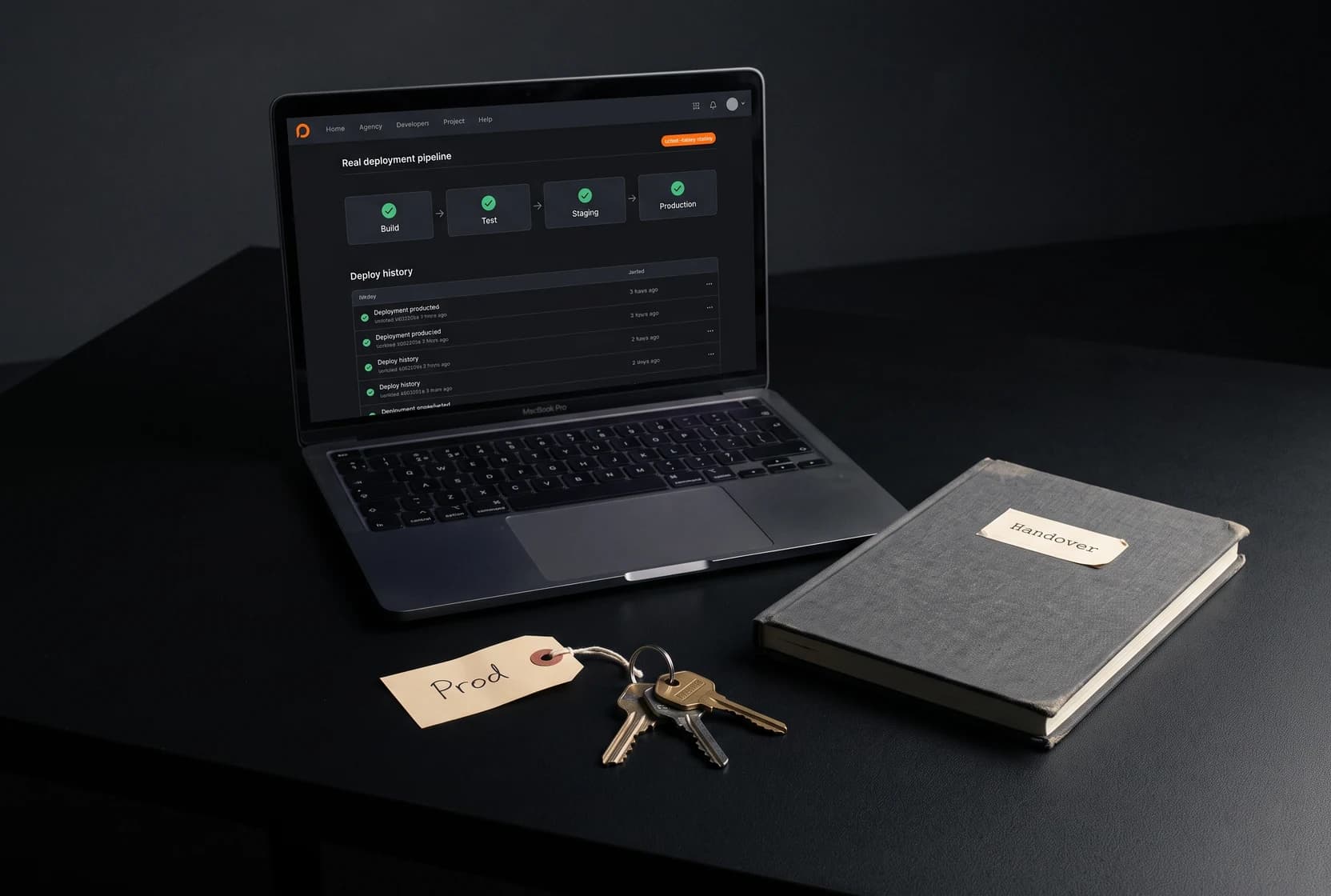
- They talk about handover unprompted. A body shop wants you dependent. A firm with standards has a handover checklist before you ask for one.
- Named people, meetable. Ask who writes the code and ask to speak to them.
- Accounts in your name. Code, cloud and domain yours from day one, not transferred at the end.
- Old references. Anyone can supply a happy client from last month. Ask for one from two years ago — that is where the quality of the handover shows.
The engagement shape that works best
In our experience the strongest arrangement is one where the client keeps product ownership and architectural direction in-house — even if that is one person — and the delivery team sits here. You keep the judgement and the context; you rent the capacity.
What makes it work in practice is unglamorous: a standing call inside the overlap window, written decisions rather than remembered ones, a demo every two weeks of something clickable, and one person on each side empowered to decide. That list is the same in every timezone. The gap just punishes you faster when it is missing.
More on the models in offshore vs nearshore vs in-house.
What we would tell you not to do
Do not run a competitive bid on price and pick the lowest. Do not skip the discovery phase to save three weeks. Do not accept a proposal with no questions attached to it. And do not hire anyone — here or anywhere — who will not tell you which part of your plan they think is wrong.
Those four mistakes cause most of the bad outcomes attributed to offshoring, and none of them are about geography.
Where to go next
If you are costing the work, start with what custom software actually costs. If you are about to go to market, how to write a software RFP that gets useful quotes will save you a round of noise.
Our own work is on the case studies page — including Signature Bangla and the restaurant POS — and we are happy to be asked the hard version of any question above. Start here.
Building something like this?
Tell us what you are trying to ship and by when. We will come back with a scope, a fixed estimate and the parts we think you should cut.
Start a conversation